Bishy Barnabees Cottage Garden Ltd
Amaranthus Dried | Red or Green Cascading Norfolk Grown
Amaranthus Dried | Red or Green Cascading Norfolk Grown
Couldn't load pickup availability
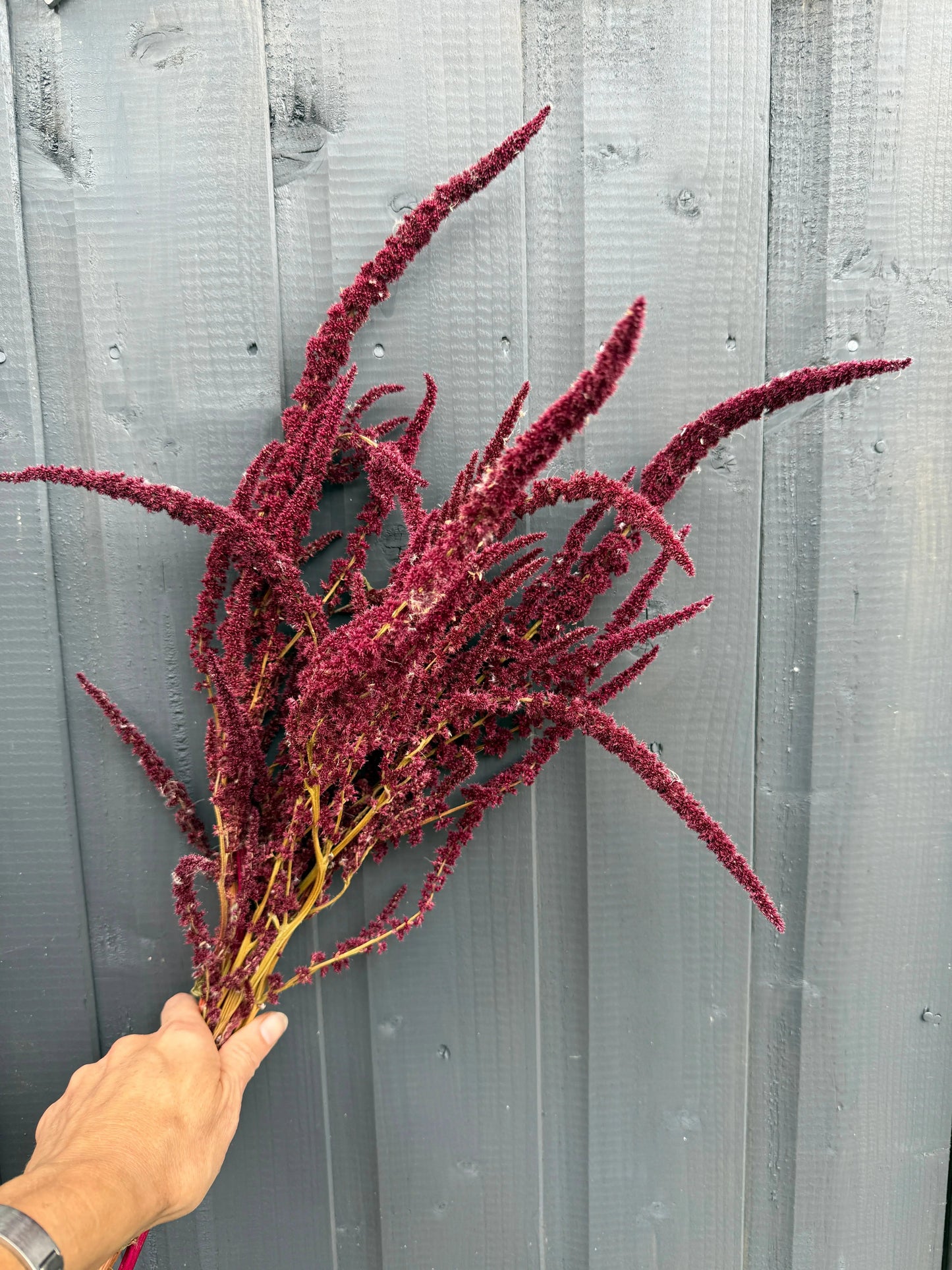
While most dried stems stand up straight, Amaranthus is designed to drape. Long, velvety ropes of tightly-packed flowers cascade downwards from tall stems like heavy chenille curtains — the only dried flower in the range that gives you genuine downward flow rather than upward structure. Available in two colours: the traditional deep crimson-burgundy of Love-Lies-Bleeding, and the fresh lime-green of the Viridis variety. Same dramatic cascading form, entirely different emotional register.
Barn-dried at Salle Moor Hall, Norfolk. Bunches of Amaranthus caudatus, each stem approximately 40-50cm long with tassels varying in length — some cascading nearly the full length of the stem itself. Hand-harvested at peak colour, hung to dry naturally in the barn to preserve the flexible drape that makes this flower distinctive. Grown chemical-free on our own cutting field. No air miles, no imported stems, no dyes or preservatives — just genuinely honest English cottage garden Amaranthus, cultivated and cared for entirely by us. Seasonal, available while our late-summer stock lasts.
Choose your colour
- Red / Love-Lies-Bleeding — the traditional Victorian cottage garden variety, drying to deep crimson-burgundy. The dramatic option: gothic, opulent, autumnal. Reads as considered drama in ceramic vessels, and as sombre romance in wedding bouquets. In Victorian floral language, Love-Lies-Bleeding meant hopeless devotion — a name to enjoy or ignore as your mood suits
- Green / Viridis — the modern minimalist alternative, drying to a soft muted lime-green that keeps its fresh character rather than fading to straw. The bright option: contemporary, clean, botanical. Works particularly well in modern white-and-green schemes, spring and summer wedding bouquets, and Scandi-minimalist interiors where the burgundy would feel too heavy
Both variants share the same cascading habit, same velvety chenille texture, and same 40-50cm stem length. The choice is purely about the aesthetic emotional register you want — sombre drama or fresh contemporary.
What makes it work
The value of Amaranthus is entirely about gravity and flow:
- Cascading tassels — the tightly-packed flower ropes hang downwards naturally, giving arrangements the "spilling" quality that no other dried flower delivers. Draws the eye downwards and softens the hard rim of any vessel
- Velvet-to-chenille texture — the flower tassels feel dry but plush, almost like velvet, pipe cleaners, or heavy chenille. Naturally flexible so they hang beautifully without breaking
- Substantial visual weight — unlike most dried flowers which read as delicate, Amaranthus has proper weight and presence. One or two stems can transform an arrangement
- Solves the "static arrangement" problem — if your dried bouquet feels stiff or lifeless, adding Amaranthus creates instant movement and drama
- Colour retention — both the burgundy and the lime-green hold their character indefinitely if kept out of direct sunlight. Unlike many dried flowers that fade to straw within months, Amaranthus keeps its colour for years
- Ancient cultivated grain plant — Amaranthus was cultivated by the Aztecs as a sacred grain crop long before it became a Victorian cottage garden favourite. Rich botanical history for customers who value provenance
Styling ideas
- The pedestal vase — place stems near the rim of a tall vase so the tassels hang down over the outside edge. Softens the hard edge of ceramic or glass, and creates the classic "spilling flower" silhouette. Works particularly well on mantelpieces, side tables, and elevated shelves where the cascade can hang without interruption
- Cascading wedding bouquets — essential for the "waterfall" bouquet look. Adds movement as the bride walks down the aisle. Red Amaranthus reads dramatic and romantic; green reads fresh and botanical. Choose to suit the wedding aesthetic
- Statement wreaths — attach at the bottom of a wreath so the tails trail downwards against a door or wall. The medieval-heraldic look for door dressings, particularly effective on dark-painted or naturally-weathered wooden doors
- Modern minimalist single-species — two or three green Viridis stems in a plain clear glass vessel makes an entirely modern sculpture. The clean lines of the drape suit gallery-white interiors surprisingly well
- Autumn styling — red Amaranthus is properly the definitive autumn dried flower. Alongside dried grasses, wheat, warm-toned seed heads, and orange or ochre elements, the burgundy anchors the whole palette
- Christmas garlands — the red variety brings cottage-garden warmth to mantelpiece garlands alongside dried orange slices, cinnamon sticks, dried eucalyptus, and pinecones
- Boho and cottagecore aesthetics — both colours work in the layered eclectic style. Red for the darker moody variant of the aesthetic; green for the fresher plant-lady version
Perfect dried companions
- Dried Pampas Grass — the texture contrast. The upright fluffy plumes of Pampas provide height while the heavy sleek ropes of Amaranthus provide the downward flow. Properly luxurious combination
- Dried Eucalyptus — the green foil. The muted grey-green of Eucalyptus leaves is a perfect backdrop for either Amaranthus colour — supporting the intense burgundy for a rich autumnal palette, or picking up the fresh lime-green for a cohesive botanical scheme
- Dried Bunny Tails — soft plush contrast against the more substantial Amaranthus. Both share the "textural" character but at completely different scales
- Dried Nigella seed heads — the structural sphere against the linear cascade. Particularly good with red Amaranthus for autumn wreath work
- Dried Achillea 'Ballerina' or Feverfew — the cream-white filler that flatters both Amaranthus colours in mixed bouquets
- Dried wheat — the harvest palette. Golden straw against burgundy red is one of the most cohesive autumn combinations
Handle with care. The tiny seeds inside the tassels can sometimes shed a little when moved vigorously — we recommend giving new bunches a very gentle shake outdoors before bringing them inside to place in your vase. Once positioned, the seeds settle. This is entirely normal for a plant that's also cultivated as a grain crop.
Care note. Amaranthus is one of the more colour-retentive dried flowers, but both burgundy and green pigments are UV-sensitive. Keep out of direct sunlight (particularly south-facing windowsills) to preserve the colour for years rather than months. Handle from the base of the stems, and let the tassels hang naturally rather than squeezing them together. If tassels get flattened during transit, gentle brushing with your fingers restores their fluffy character.
Growing your own. Amaranthus caudatus is one of the easiest dramatic annuals to grow from seed — direct-sown in April or May in full sun, it produces massive spectacular plants by late summer with cascading tassels that continue drying naturally on the plant if left alone. Bees, butterflies and hoverflies work the flowers throughout summer. Bishy sells Amaranthus seeds in both varieties — growing your own gives you the summer garden performance (properly one of the most spectacular cottage garden annuals) and the autumn drying harvest.
Share